Airplanes

Scratch-built Caproni Stipa - The Flying cannelloni

1/72 scale

by Gabriel Stern © 2006 Modeler Site

Legal Notice

No material from Modeler Site any Web site owned, operated, licensed, or controlled by Damian Covalski may be copied, reproduced, republished, uploaded, posted, transmitted, or distributed in any way, except that you may download one copy of the materials on any single computer for your personal, non-commercial home use only, provided you keep intact all copyright and other proprietary notices. Modification of the materials or use of the materials for any other purpose is a violation of Damian Covalski's copyright and other proprietary rights.

Read More here > Legal notice


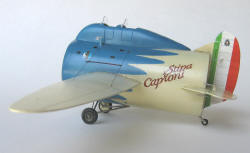
What exactly is -or was- a Caproni Stipa?. The simila similaribus curator principle of homeopathic medicine states -don't correct me if I'm wrong- that a similar substance heals a similar illness. Hence we can assume that Count Caproni, famed for his bias toward extremely "innovative" designs (do you, by any chance, know about his triplane hydroplane?) associated with Mr. Luigi Stipa in order to get cured. Did it work? We'll see.


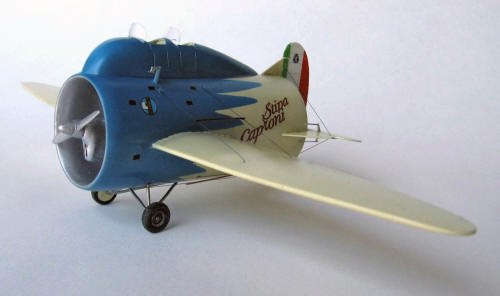
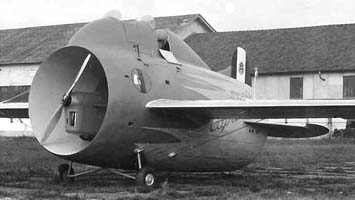
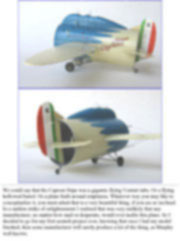
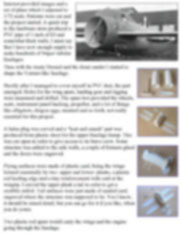
We could say that the Caproni Stipa was a gigantic flying Venturi tube. Or a flying hollowed barrel. Or a plane built around emptiness. Whatever way you may like to conceptualize it, you must admit that is a very beautiful thing, if you are so inclined.

In a sudden strike of enlightenment I realized that was very unlikely that any manufacturer, no matter how mad or desperate, would ever tackle this plane. So I decided to go for my first scratch project ever, knowing that once I had my model finished, then some manufacturer will surely produce a kit of the thing, as Murphy well knows.

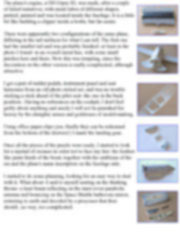
Internet provided images and a set of plans which I adjusted to 1/72 scale. Patterns were cut and the project started. A quick trip to the hardware store produced a PVC pipe of 1 inch of ID and somewhat thick walls. I must say that I have now enough supply to make hundreds of Stipas' tubular fuselages.

Then with the trusty Dremel and the drum sander I started to shape the Venturi-like fuselage.


Shortly after I managed to cover myself in PVC dust, the part emerged. Holes for the wing spars, landing gear and rigging were measured and drilled. The spare box provided the wheels, seats, instrument panel backing, propeller, and a lot of things like alligators, dragon eggs, mustard and so forth, not really essential for this project.


A balsa plug was carved and a "heat and smash" part was produced from plastic sheet for the upper fuselage hump. This was cut open in order to give access to its brave crew. Some structure was added to the side walls, a couple of formers glued and the doors were engraved.


Flying surfaces were made of plastic card, being the wings formed essentially by two -upper and lower- planks, a plastic rod leading edge and a tiny reinforcement with card at the wingtip. I curved the upper plank a tad in order to get a credible airfoil. Tail surfaces were just made of sanded card, engraved where the structure was supposed to be. Yes I know, it should be raised detail, but you can go for it if you like, when you do yours.


Two plastic rod spars would carry the wings and the engine going through the fuselage.


The plane's engine, a DH Gipsy III, was made, after a couple of failed tentatives, with metal tubes of different shapes, puttied, painted and was located inside the fuselage. It is a little bit like building a clipper inside a bottle, but far easier.


There were apparently two configurations of the same plane, differing in the tail surfaces for what I can tell. The first one had the smaller tail and was probably finished -at least in the photo I found- in an overall metal hue, with some small patches here and there. Now this was tempting, since the decoration on the other version is really complicated, although attractive.


I got a pair of rudder pedals, instrument panel and seat harnesses from an old photo etched set, and was no trouble sticking a stick ahead of the pilot seat -the one in the back position-. Having no references on the cockpit, I don't feel guilty about anything and surely I will not be punished for heresy by the almighty muses and goddesses of model-making.


Using office paper clips (yes, finally they can be redeemed from the bottom of the drawers!) I made the landing gear.


Once all the pieces of the puzzle were ready, I started to look for a myriad of excuses in order not to face my fate: the feather-like paint finish of the beast, together with the emblems of the era and the plane's name inscription on the fuselage side.


I started to do some planning, looking for an easy way to deal with it. What about -I said to myself seating on the thinking throne- a laser beam reflecting on the mars rover parabolic antenna and bouncing on the Space Shuttle bathroom mirror, returning to earth and decoded by a processor that then should...no way, too complicated.


Perhaps I should surrender myself to the arcane, deep mysteries of image-processing programs and print my own decals...and so I did for the "Caproni Stipa" legend, but I also found the crests in my spare decals zip bag.


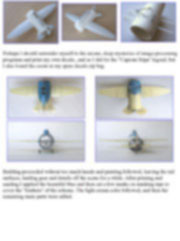
Building proceeded without too much hassle and painting followed, leaving the tail surfaces, landing gear and details off the scene for a while. After priming and sanding I applied the beautiful blue and then cut a few masks on masking tape to cover the "feathers" of the scheme. The light cream color followed, and then the remaining main parts were added.


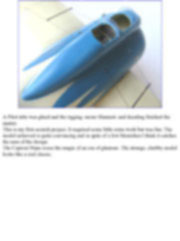
A Pitot tube was glued and the rigging -mono filament- and decaling finished the matter.

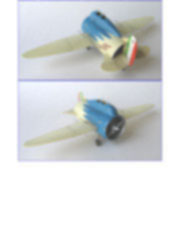
This is my first scratch project. It required some little extra work but was fun. The model achieved is quite convincing and in spite of a few blemishes I think it catches the aura of the design.

The Caproni Stipa oozes the magic of an era of glamour. The strange, chubby model looks like a real classic.


Support us ordering our notes in PDF > Here