|
|
|||||||||||||||||||||||||||||||||||||||
|
Cars |
|
||||||||||||||||||||||||||||||||||||||
|
Restoring a vintage R/C Tamiya truck... like a shelf model |
|||||||||||||||||||||||||||||||||||||||
|
by Mario Covalski © 2005 Modeler Site |
|||||||||||||||||||||||||||||||||||||||
|
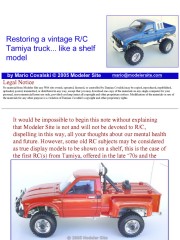
Legal Notice No material from Modeler Site any Web site owned, operated, licensed, or controlled by Damian Covalski may be copied, reproduced, republished, uploaded, posted, transmitted, or distributed in any way, except that you may download one copy of the materials on any single computer for your personal, non-commercial home use only, provided you keep intact all copyright and other proprietary notices. Modification of the materials or use of the materials for any other purpose is a violation of Damian Covalski's copyright and other proprietary rights. Read More here > Legal notice It would be impossible to begin this note without explaining that Modeler Site is not and will not be devoted to R/C, dispelling in this way, all your thoughts about our mental health and future. However, some old RC subjects may be considered as true display models to be shown on a shelf, this is the case of the first RC(s) from Tamiya, offered in the late ‘70s and the early ‘80s. This article aims at sharing, with those who have never tackled a project like this, my experience restoring these collection pieces, giving you a short introduction about them. If you find this note interesting, I advise you to surf the web, (some links will be encountered at the bottom of the current article) where you’ll find much and good information on these models.
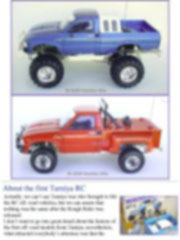
About the first Tamiya RC
By that time, road, sport, F1 and F2 RC model cars were abundant, but the first pickup which saw light in 1981, was the Ford F150 ranger, a chassis that had nearly nothing to do with the subject that represented the body; it was a 1/10 Sand Sorcher chassis with a 1/12 pickup’s body.
The battery Tamiya developed was a special 6 volt 4000 mA/hour (6 volt and 1200 mA batteries were commonly used) which allowed the model run during 30 minutes without needing to be charged. In spite of the success the Hilux had from the point of view of this magnificent piece, it was a failure speaking about its use as a radio controlled toy, showing mistakes on its design that turned it in somewhat boring. In general, it was not used more than a few hours and, if anybody decided to use it as an off-road vehicle, it would finish with any vital part broken.
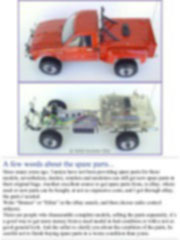
Why are most of these models collection pieces? Any plastic kit might be reissued even when the manufacturer that originally had offered it, would have closed. However, and although this has not been said, everybody knows that Tamiya will never release old radio controlled models, they would not be able to compete with the current technology, they would not have a significant value any more, and probably the manufacturing cost would be higher than the sale cost. So, they turn in collection pieces, and for instance, a 1981 Hilux which originally cost US$400, can be sold today through eBay around 2000-2500, while a mounted model with nearly no use in 1200-1500, and a very worn one around US$600. It’s not usual to see somebody buying these models to be built, in general they are bought for collection purposes, but even if built, they are just to be added to the shelf with other collection pieces. Actually, buying a kit like this, is almost unaffordable for most of us ( and they seldom can be found on sale), so we usually tend to buy one to be restored as if it had been built straight from the box, trying to use as many original parts as possible. At the bottom of this article, You’ll find some links where to get the necessary parts in case of need, and a model in itself just in case you want to start a restoration. This note is offered in PDF format to be read or printed using Acrobat reader, contact our webmaster > Here Include more than 92 pics, here we show only the text pages.
Support us ordering our notes in PDF > Here |
|||||||||||||||||||||||||||||||||||||||